Friday, June 19, 2009

Missio Dei - #2: It's About Jesus


Wright says that "mission is what the Bible is all about". Like I said previously, I can agree with this for the most part. The Bible is about God, His character and His deeds, with the two being intimately connected (as all our characters and deeds are). We may denote God's deeds -- past, present, and future -- as His mission, so yes, mission is what the Bible is all about. However, where does Jesus of Nazareth fit into this? As Christians we were taught by Jesus Himself to read Scripture christocentrically, so how do a missional reading of the Bible and a christological reading of the Bible relate to one another?

Luke 24 has the answers.

Then He (Jesus) said to them, "These are My words that I spoke to you while I was still with you, that everything written about Me in the Law of Moses and the Prophets and the Psalms must be fulfilled." Then He opened their minds to understand the Scriptures, and said to them, "Thus it is written, that the Christ should suffer and on the third day rise from the dead, and that repentance and forgiveness of sins should be proclaimed in his name to all nations, beginning from Jerusalem. You are witnesses of these things. - Lk. 24:44-48

The call to a messianic or christocentric reading of Scripture is obvious here - "...everything written about Me..." However, there is a second and equally important lens through which to read the Bible, and that is the work of Christ as it fits definitively into the mission of God. Jesus is saying that if you read Scripture in light of Me, you will find that it is about Me and what I have done, and you will also see that it is about taking the message about Me to all the nations.

In other words, a christocentric reading of Scripture and a missional reading of Scripture are basically two sides of the same coin. There is also a sort of paradox, whereby the death and resurrection of Jesus is the fulfillment of the mission of God, but also the catalyst. Most Christians get the fulfilment part, but fail to grasp the catalyst part, which is actually the part we are useful for - the proclamation of repentance and forgiveness of sins to all nations. Wright says that,

The full meaning of recognising Jesus as Messiah...lies in recognising also His role in relation to God's mission for Israel for the blessing of the nations.

And so the Bible is not just full of proof-texts about Jesus, but full of God's intentions to bless all the nations and thus bring glory to His name. Thus when we read the Bible we ask:

What is it saying about 1) the person of God and 2) the purposes of God?

Our answers should be found in Jesus, who is the image of the invisible God, and God's chosen Servant through whom He would bring blessing to all the nations of the earth. This, in a nutshell, is missio Dei.

Does it make good sense to read the Bible from this missional perspective? Does this hermeneutic do justice to Scripture? These are the questions answered in the next couple of chapters.

Thursday, June 18, 2009

Christian?

What makes somebody a Christian? What does it mean to be a Christian? It is quite clear that not everybody who professes to be a Christian is a Christian. Should Christians care about this, in the sense of doing something about it? At what point does one Christian have the responsibility to tell another professing Christian that they are not in fact a Christian at all? Or does nobody but God have the right and responsibility to declare our status, since he alone knows our hearts?

Is the Christian life a journey, or is it a one-time deal where once you're in you're in? Or is it somehow both?

Again, what makes somebody a Christian? A decision? A feeling? A thought? A lifestyle? A declaration? An act? Knowledge? Some kind of combination of two or more of these things?

What makes me a Christian? Because I pray semi-regularly? Because I got scared into salvation 14 years ago? Because I go to church on Sunday? Because I know that it's only by faith in Jesus that I am justified before God? Because I keep a pseudo-theological blog? Because I obey more of the rules than others? Because I claim to have accepted God's forgiveness and grace? Because I am constantly reading Christian literature?

A final point - if it's possible to profess Christianity and not be a Christian, is it also possible to deny Christianity and be a Christian, or am I just silly even asking that?

Anyway, let's discuss. I'm tired of feeling like I'm writing to myself all the time, even if it's true. If you identify yourself as a Christian, what makes that identity genuine? And if you're not a Christian, what do you think makes somebody else a Christian? If people respond then I'll try and tackle some of the above questions myself at some point, but if nobody responds then I'll assume disinterest amidst my readership and move swiftly on.

Missio Dei - #1: It's About God


Anyone who has followed this blog for the past couple of months will be aware of my interest in the narrative that is found in the Bible, or perhaps the narrative that the Bible finds itself in. Well, as a cultivation of that interest I decided to add The Mission of God: Unlocking the Bible's grand narrative to my books-to-get list. I planned to order it off Amazon, but as I performed my almost weekly peruse of the Aisling bookshop here in Galway I saw Christopher J.H. Wright's hefty book sitting snug on the top shelf. The price tag was irrelevant: I was buying this book right now, and economical sense was not going to stop me.

Anyway, now that I have this book, I'm going to do something different with it. Yes, I'm still going to read it, but I'm also going to write about it as I read it. Not so much a book review, but more reflections on what I'm reading. It's a big book so this could take a while, but I have a good feeling that this will be both interesting for you the reader of this blog and beneficial for me the reader of this book. I'll keep the posts as short as possible, and only dwell on areas that demand prolonged dwelling.

Now, to set the stage...

What is this book? Is it a biblical theology of mission, or a missional reading of the Bible? Wright says that it is both, but probably more the latter. The fact that is more the latter excites me.

You see once again the question, "What is the Bible?" or "What is the Bible all about?" comes into play. Often we as Christians see it as some kind of independent authority, the world's instruction manual. The Bible tells us how things are supposed to work; how should human beings interact with one another?; what are we supposed to be doing with our lives?; what is the correct code of behaviour? We have our various questions, and the Bible provides authoritative answers to those questions.

Relating this to mission, the Bible is also used as a basis for why mission exists. We derive our theology of mission from words of Scripture such as "Go ye therefore and make disciples of all nations..." In short, it is clear that the Bible tells us to do mission work, therefore we should do mission work. End of story.

However, I think such an approach to Scripture misses the crucial point that the Bible is caught up in something bigger than itself. The Bible is an indispensable book for many reasons, but the main reason is that it is a signpost to a greater authority, a greater reality. It is a book that is part of a big story - a story about its Author's character and deeds - and Wright argues that it should be read and interpreted with this story (the mission of God) as a framework.

We all have our different frameworks for interpreting the Bible - we can have a 'how does this benefit me?' framework, a feminist framework, an informational framework where we just want to know as much as possible about the Bible. Wright argues for a missional framework (or hermeneutic).

At first this sounds very people-centred. "Mission is what we do" is the assumption. This assumption is true to a certain degree. Mission is indeed something we do, but it is only something we do as participants in God's grand mission of which the Bible speaks. Wright says that "the whole Bible is itself a "missional" phenomenon" and that it is "the product of a witness to the ultimate mission of God". He goes on to write that

Mission is not just one of a list of things that the Bible happens to talk about, only a bit more urgently than some. Mission is, in that much-abused phrase, "what it's all about."

I wrote in a previous post that the Bible is about God. It's about who God is, and what He has done, is doing, and will do. It's about His person and His purposes, with the two being absolutely inseparable. The mission of God has to do with the purposes of God which flow from His person, and so to say that mission is what it's all about is not a stretch in my view provided we know whose mission we are talking about.

"The Bible presents to us a portrait of God that is unquestionably purposeful." So often we get caught up in our own purposes to the point where we will even hurt others in order to achieve them. Our individual purposes, our own little kingdoms that we rule over, are the highest authority. We answer to our desires, be they good or bad. The Bible portrays a God who is purposeful, and whose purposes are good and right and true. Wright's book aims to seek out those purposes, and to help us read the Bible with missio Dei -- the mission of God -- as the controlling narrative.

I'm excited about what lies ahead.

Tuesday, June 16, 2009

Go To Texas

The photographer for my brother's wedding is staying over in our house at the moment, and he showed us a couple of shots he took back home in Texas which in my admittedly amateur opinion are incredible. They just make me want to watch Friday Night Lights or listen to Explosions in the Sky, or perhaps just go to Texas. Anyway, here they are, taken(without any permission whatsoever) from his blog. Enjoy.


Monday, June 8, 2009

God is Cruciform

There has been much talk around these parts recently of knowing God primarily through Jesus. However, within that primary means of knowledge lies a further primary revelation of who God is. We do not primarily know who God is through an examination of Jesus' prayer life; we do not primarily know who God is by wrapping our heads around Jesus' ethical teaching; we do not primarily know who God is by marveling at Jesus' many miracles. As important as these things were to His life and ministry, it is the Cross to which we must look if we are to have a revelation of who Jesus is, and therefore who God is.

In his book with the snappy title, Inhabiting the Cruciform God: Kenosis, Justification and Theosis in Paul's Narrative Soteriology, Michael Gorman makes the simple and yet profound point that God is cruciform. That is, God is shaped like a cross. Through this Ancient Roman method of capital punishment we find a definitive revelation of God breaking through.

We don't -- or at least I don't -- often think of the cross in such a way. Usually the cross is seen by Christians as an event -- the event -- through which sins were once for all dealt with. It is of course nothing less wondrous than that, but there is yet more. There is revelation to be seen at the foot of the cross. The character of God -- indeed the heart of God -- is on display every time we survey the cross of Christ. There on Calvary He showed power in weakness, glory in humility, love in pain. Moreover, this is what genuine divinity looks like. Jesus' call for His disciples to follow His example of servanthood in Mark 10 was nothing less than a call to theosis - conformity to the image of God.

"You shall be cruciform, for I am cruciform" is how Gorman paraphrases God's call for His people to be holy, because holiness is now to be understood in the light of the cross. Our response to this revelation is emulation, not merely by our own efforts of course, but by the power of the cruciform God who works within us.

My problem is that I don't always want to be cruciform. And yet in my clearest moments I realise that there is nothing more beautiful, nothing more powerful, than a life lived for the sake of others. This is the life of the Kingdom, and we see it no more manifestly than on the cross where the Son of God loved us and gave Himself for us.

Sentence of the Day:


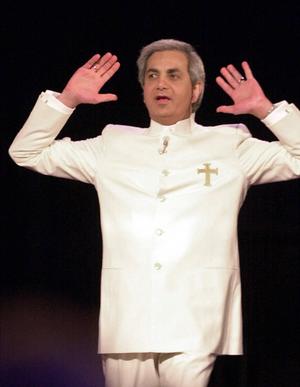
Runner-up: "Benny Hinn is recognised as a Christian healing evangelist and Bible teacher."

I hope that was said with tongue firmly in cheek.

The winner: "Benny Hinn Ministries is not a member of the Evangelical Council for Financial Accountability."

Yep, I'm as surprised as you are to read that...

By the way, is it just me or does Benny Hinn's outfit remind you of Dr No's in the first Bond film? They must have the same tailor.

Saturday, June 6, 2009

Presence

"Presence is a delicious word - because it points to one of our truly great gifts. Nothing else can take the place of presence, not gifts, not telephone calls, not pictures, not mementos, nothing. Ask the person who has lost a lifelong mate what they miss the most; the answer is invariably 'presence'. When we are ill, we don't need soothing words nearly as much as we need loved ones to be present. What makes shared life - games, walks, concerts, outings, and a myriad of other things - so pleasurable? Presence." - Gordon Fee

Wednesday, June 3, 2009

A New Body

In a sort of belated nod to Pentecost Sunday, here is a Charles Price quote which is quite provocative on first hearing. The context is that according to Price, two things happened on the day of Pentecost. The first and most obvious things is that the disciples received the Holy Spirit, as Jesus promised they would. But, as Charles Price goes on to say,

"...a second thing happened on the Day of Pentecost that is equally important and that we must understand. And it is this: Jesus Christ received a new body. God gave the Spirit to those waiting disciples and He gave to His Son a new body."

The key to understanding this is to understand that these aren't two distinct happenings. The Holy Spirit is elsewhere called the Spirit of Christ. This is why Paul could say in Galatians that "it is no longer I who live, but Christ who lives in me". Paul understood this reality very well, for it was the risen Jesus who asked Saul the persecutor of the church, "Why are you persecuting me?" Not, "why are you persecuting my followers?" but "why are you persecuting me?"

The consequences of this are such that we'd rather not believe any of it to be true. We'd rather separate Christians from Christ, because that makes it easier to treat them in whatever way takes our fancy. We may not articulate it, but in our minds Jesus is up in the clouds somewhere waiting for God to let Him out of the traps and come back to earth again, but in the mean time we just have to get by with some abstract notion of the Holy Spirit -- the lesser person of the Trinity.

This is obviously untrue, but do we really know what the truth is? And not just in words, but in experienced reality? Do we even want to know? Do we want the responsibility of truly being a member of Christ's body? Do we want to be the ones to carry out His purposes? Do we want to look at our brothers and sisters in the church with the knowledge that what we are doing and saying to them is what we are doing and saying to the Messiah?

Cast your mind back to the first verse of the Book of Acts. Luke tells Theophilus that the Gospel he wrote was an account of what Jesus began to do and teach. The implication is that the second volume -- Acts -- is what Jesus continued to do and teach through His new body empowered on the Day of Pentecost.

There are some pitfalls to be avoided of course. I am not the Messiah; I'm a very naughty boy. It's not like the climax of the film Spartacus, where all Christians stand up and say "I'm Jesus". There is a sort of paradox, where we point away from ourselves and towards the risen crucified Lord, and yet we are intimately united with this Lord and thus members of His body and empowered by His Spirit.


ps - I love paradoxes. I think I'm going to write a book on theological paradoxes some day.

Tuesday, June 2, 2009

Father and Son

There is so much to be digested from the first twenty verses of Colossians - the grace of God, the spreading of the gospel, the love of the saints, the prayer of Paul, the christological hymn - that one of the threads running right through the passage almost escaped me and my less-than-practiced eye. It's a thread found predominantly in the Gospel of John, but which finds a prominent place here in a Pauline prison epistle - the relationship between the Father and the Son, between Theos and Kyrios, between God and Jesus, between...well, you get the point. It would take a whole book to plumb the depths of this relationship as delineated in Colossians, but here are the pertinent verses which I may come back to over the coming weeks:

"Paul, an apostle of Christ Jesus by the will of God, and Timothy our brother..." - 1:1

In other words, God has charged Paul with the task of proclaiming Jesus as the long-awaited Messiah. What does God want to do? Well, He wants to make Jesus known.

"We always thank God, the Father of our Lord Jesus Christ, when we pray for you..." - 1:3

Paul understood God as being the Father of Jesus (though in what sense will have to remain unexplored here and now), but he uses a title for Jesus that is quite shocking in the context of monotheistic Judaism. In the Septuagint (the Greek translation of the Old Testament), the word Kyrios is used for the Hebrew name Yahweh (or YHWH), which is God's personal name; the name given to Moses at the burning bush; the name which means "I AM". In most of our Bibles this name is translated as LORD, all capital letters. Well, here Paul uses that same word -- the word Kyrios -- to denote Jesus. This is the name above all other names that we find in Philippians 2. There Paul says that at the sight of Jesus all people will bow down and confess Jesus as Kyrios, as Yahweh, as Lord, and it will be to the glory of God the Father.

Already in the opening verses we see the selfless love of the Godhead in action: The Father charges Paul to make His Son known, and (admittedly with help from Philippians) the Son's goal is to give the glory to the Father.

"And so, from the day we heard, we have not ceased to pray for you, asking that you may be filled with the knowledge of His will in all spiritual wisdom and understanding, so as to walk in a manner worthy of the Lord, fully pleasing to Him*, bearing fruit in every good work and increasing in the knowledge of God..." - 1:9-10

Again it is God's will that is at the forefront, and what's more, knowing this will is linked to living the kind of life Jesus lives. The other side of this coin is that looking at the kind of life Jesus lived on earth is to look at the will of God incarnated. Why did Jesus do what He did? Because it was the will of His Father. His life was the enfleshment of God's character, and so it is little wonder that such a life is fully pleasing to God. Note also the word "spiritual" in this passage, which as Gordon Fee points out, should be translated as "Spiritual", i.e. "of the Spirit/pertaining to the Spirit". Here we have Father, Son, and Spirit in intimate connection with one another.

"...giving thanks to the Father, who has qualified you to share in the inheritance of the saints in light. He has delivered us from the domain of darkness and transferred us to the kingdom of His beloved Son, in whom we have redemption, the forgiveness of sins." - 1:12-14

The Father qualifies people and takes them out of the rule of a broken, corrupt world. What is interesting is where He puts these people - He puts them into the Kingdom of His Beloved Son. The term "Kingdom of God" is familiar to us from the Gospels, but the term "Kingdom of Jesus" is not so common. I think I like the latter term better. As I said in a previous post, the word "God" evokes much that is theologically false, but when we think of Jesus we think of compassion, grace, and self-giving love amongst other things. The kingdom God has already brought Christians into is a kingdom where the risen crucified Jesus is King. As the Disney Song says, "The Lamb becomes our Shepherd King; We'll reign with Him".

Of course I'm not pitting God and Jesus against each other. The Kingdom of Jesus is the Kingdom of God. The compassion, grace and self-giving love of Jesus is the compassion, grace and self-giving love of God. This fact is said most clearly in the following verses...

"He is the image of the invisible God, the firstborn of all creation." - 1:15

"For in Him all the fullness of God was pleased to dwell, and through Him to reconcile to Himself all things, whether on earth or in heaven, making peace by the blood of His cross." - 1:19-20

These are weighty passages of Scripture, especially vv. 19-20. In these words we hear echoes of Paul's earlier statement to the church at Corinth - "God was in Christ reconciling the world to Himself". The Jesus who went to the cross in obedience to the Father and out of love for sinners was not the "good cop" in the Trinity. The "bad cop" Father didn't leave Jesus alone to do the redemptive work on the cross while He sat on the clouds self-righteously. All God's fullness was in Christ as He took the judgement of the world upon Himself; as had been quoted on this blog before, the Judge took the Judgement on Himself. Father and Son were in on this redemptive work together in a big way.